
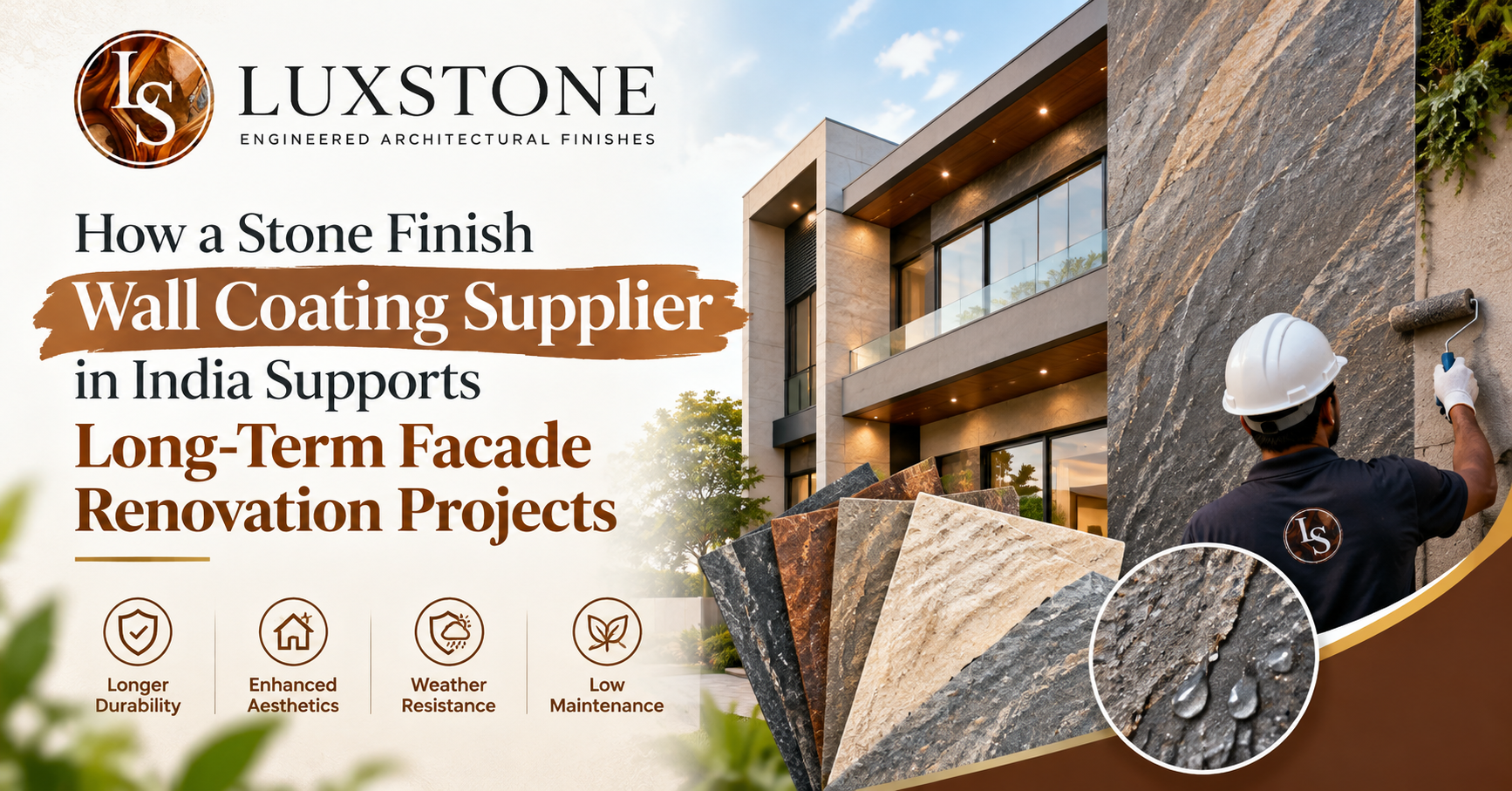
Long-term facade renovation is more than making an old building look new. The wall finish chosen needs to work with the surface, match the building's style, handle outdoor conditions, and be easy to care for. A Stone Finish Wall Coating Supplier in India helps with this by offering coating solutions, finish choices, advice on how to apply them, and consistent materials for renovation projects.
For architects, builders, contractors, and property owners, the right supplier can make it easier to plan the facade renovation and help keep the look the same across projects or those done in stages.
Key Takeaways
- Facade renovation needs a balance between how it looks, the condition of the surface, and how well it performs over time.
- Stone finish coatings can give walls a new look that looks like real stone.
- Supplier help makes it easier for project teams to choose the finishes based on the building and what is needed.
- Having the materials available is especially important for big projects or those done in parts.
- Good surface preparation and the right application are needed to get the look you want.
Why Long-Term Facade Renovation Needs the Right Material
Building facades face sunlight, rain, dust, humidity, and temperature changes all the time. Over time, these can change how the outside looks and how it is.
Fading, stains, surface damage, and old finishes can make a building that is otherwise in shape look old. Renovation gives a chance to make the outside look better while picking a finish that works with what it will face.
A stone finish wall coating supplier in India can add texture, depth, and a real stone look to walls that're already there. Without doing big changes to the structure, the renovation team can use the right surface treatment to make the building look much better.
The Role of a Supplier in Facade Renovation
A Stone Finish Wall Coating Supplier in India can contribute to a renovation project at several stages rather than simply supplying the finished material.
Every renovation project has different requirements. An older residential facade may have a different surface condition from a commercial building or institutional property. Similarly, a highly exposed exterior wall may require different considerations from a sheltered architectural feature.
Suppliers can provide information about available textures, finishes, application methods, and product suitability. This allows architects and contractors to make material decisions based on the actual requirements of the project instead of choosing a finish only for its appearance.
Evaluating the Existing Facade Before Application
A successful renovation starts with understanding the existing wall.
Older facades may contain previous paint layers, accumulated dirt, surface cracks, loose particles, or areas affected by moisture. These conditions should be identified before a new coating is applied.
The existing surface must be suitably prepared according to the selected coating system. Loose or unstable material may need to be removed, while cracks and other surface defects should be addressed separately.
A decorative coating should not be treated as a substitute for repairing serious structural or moisture-related problems. Proper assessment creates a more reliable foundation for the renovation work.
Bringing a Natural Stone Appearance to Older Buildings
One of the main attractions of stone finish wall coatings is their ability to transform plain or ageing surfaces with a textured, natural-looking finish.
Texture creates visual depth and can make large walls appear more substantial than a conventional smooth painted surface. Depending on the selected product, the finish can have different levels of grain, texture, and visual character.
This can be useful when renovating villas, apartment buildings, commercial properties, offices, hospitality spaces, and other structures where the facade plays an important role in the property's overall appearance.
Supporting Different Architectural Design Directions
Facade renovation does not always mean recreating the original appearance. Many property owners use renovation as an opportunity to give an older building a more contemporary identity.
Stone finish coatings can support both traditional and modern design approaches. A subtle finish can complement minimalist architecture, while a more pronounced texture can be used on feature walls or selected facade sections.
Designers can also combine textured surfaces with glass, metal, concrete-inspired finishes, and other architectural materials to create contrast without making the facade visually disconnected.
Why Material Consistency Matters Over Multiple Phases
Large renovation projects are often completed in stages. A commercial complex may be renovated block by block, while a residential development may require facade work across several buildings.
In these situations, material consistency becomes particularly important. Differences in texture, colour, or surface appearance between phases can become noticeable when renovated sections are located next to one another.
Working with an established Stone Finish Wall Coating Supplier in India can help project teams plan their material requirements and maintain greater consistency throughout the renovation schedule.
For long-duration projects, discussing future material requirements with the supplier in advance can also make procurement more organised.
Choosing Materials for India's Diverse Climate Conditions
India's climate varies considerably between regions. Buildings may experience intense sunlight, high humidity, heavy rainfall, dust, or substantial temperature changes depending on their location.
These environmental conditions should be considered when selecting an exterior wall coating.
A supplier with experience in architectural coating applications can help project teams understand the characteristics of available materials and identify options appropriate for the intended use. The final selection should always consider the building's exposure, wall condition, and product specifications.
Surface Preparation Is Critical to Renovation Quality
Even a well-designed stone finish cannot deliver its intended result when applied over an unsuitable surface.
Surface preparation may involve cleaning the wall, removing loose material, and dealing with existing defects before application. The exact preparation process depends on the condition of the facade and the requirements of the selected product.
This stage is particularly important during renovation because existing buildings may have several layers of previous finishes. A properly prepared surface helps create better conditions for uniform application and a consistent final appearance.
How Supplier Guidance Helps Contractors
Facade renovation involves coordination between architects, contractors, applicators, property owners, and procurement teams. Misunderstandings about texture, application, coverage, or preparation can result in delays and inconsistent finishes.
Supplier guidance can help establish clearer expectations before work begins. Product information and application recommendations can give contractors a reference for handling the material correctly.
Creating a physical sample or mock-up is also valuable for larger projects. It allows stakeholders to review the actual finish under natural lighting and approve the appearance before full-scale application.
Common Mistakes in Facade Renovation
Choosing a coating purely because it looks attractive in a catalogue or sample is one common mistake. The selected finish also needs to be suitable for the building's surface and environmental exposure.
Another mistake is failing to plan material requirements for future renovation phases. If the same finish needs to be reproduced later, availability and consistency should be considered from the beginning.
Ignoring surface preparation can also compromise the final result. Applying a new texture over unstable or unsuitable surfaces may affect adhesion and appearance.
Finally, using too many different textures across one facade can make the building appear visually inconsistent. Material variation should support the architectural design rather than compete with it.
What to Discuss With a Stone Finish Wall Coating Supplier
Before finalising a coating, project teams should discuss the intended application, existing surface condition, available textures, finish options, and application requirements.
For exterior renovation, exposure to sunlight, rain, and other environmental conditions should also be considered. Architects and contractors can request product information and samples to evaluate the finish before approving it.
For large or phased projects, material availability and future supply should be discussed as well. This becomes especially important when the renovation schedule extends over several months or involves multiple building sections.
How the Right Supplier Adds Long-Term Value
A renovation project should be considered beyond its immediate visual transformation. The selected material and supplier can influence how easily future maintenance, repairs, or additional facade work can be coordinated.
A reliable supplier can support this process through consistent material availability, product information, finish options, and application guidance. These factors become increasingly valuable when the project involves large surfaces or multiple renovation phases.
The supplier therefore becomes part of the broader renovation process rather than simply a source of coating material.
Final Thoughts
Long-term facade renovation requires thoughtful material selection, proper surface preparation and coordination throughout the project. A stone finish wall coating can refresh an ageing building while introducing texture, depth and a natural material character to its exterior.
For architects, builders, contractors and property owners, choosing an experienced Stone Finish Wall Coating Supplier in India can help simplify material selection, support application planning and maintain consistency across larger renovation projects.
Luxstone Texture offers natural stone-based texture solutions for interior and exterior applications, helping renovation projects achieve a distinctive architectural finish while addressing practical surface requirements.