
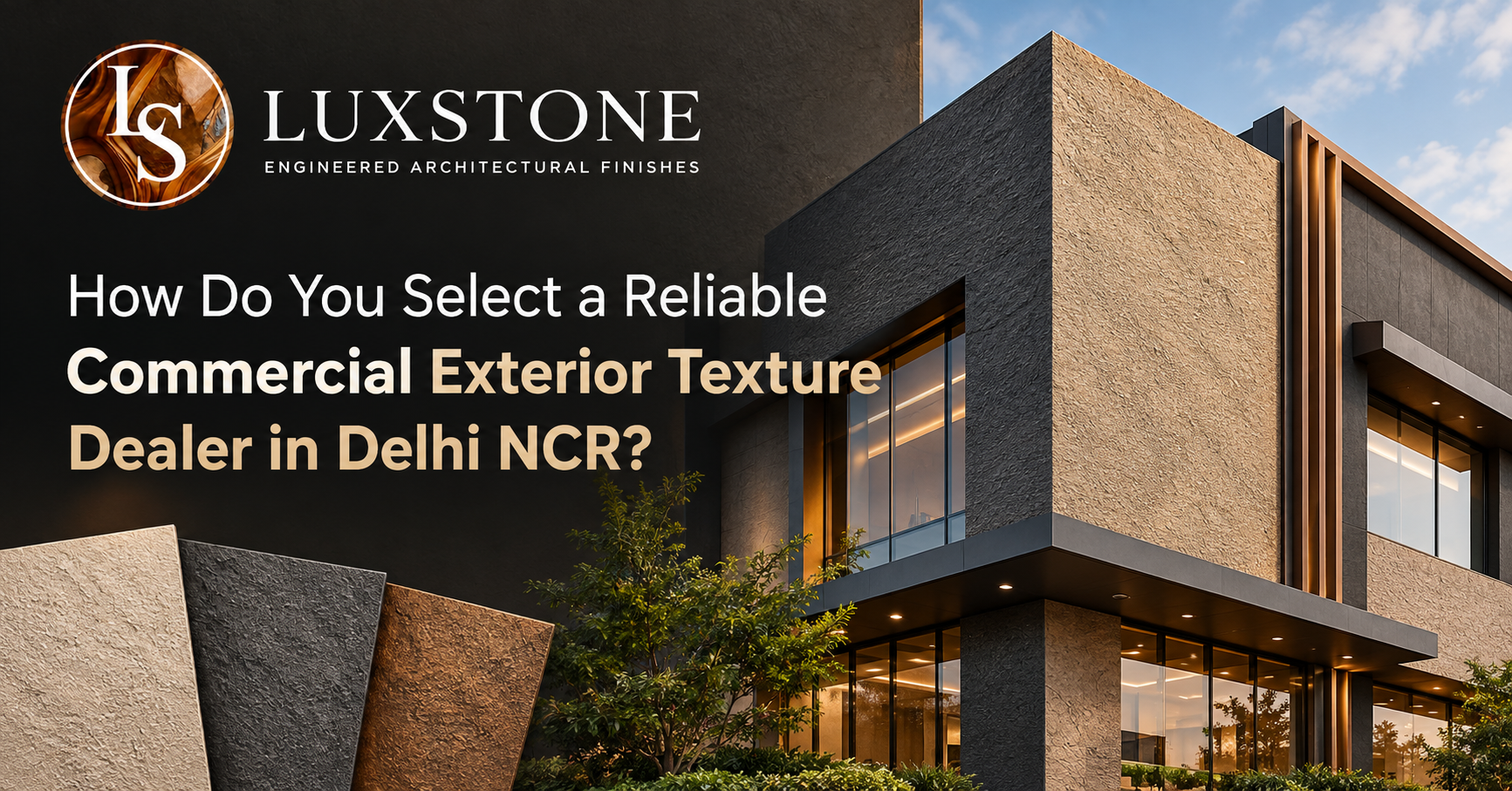
It is important to look beyond the aspects of availability and pricing when choosing an appropriate Commercial Exterior Texture Dealer in Delhi NCR. With regard to the use of coatings on the exteriors of buildings, there are certain kinds of coatings that should be used according to the nature of the building itself.
It is important to take into consideration the following issues, such as the quality of the products, availability of various textures, reliability of manufacturers, data, availability of samples, etc.
Key Points
- Assess the quality and performance characteristics of the exterior texture before buying.
- Ascertain whether the dealer provides textures and finishes appropriate for commercial facades.
- Get samples of the product before finally choosing the material.
- Factor in product consistency and production capacity in case of large-scale projects.
- Technical support may be useful in some situations.
- Choose a dealer that is able to explain product suitability.
Why Choosing the Right Commercial Exterior Texture Dealer Matters
Commercial buildings often have extensive facade areas, making material selection an important part of the project. A small inconsistency in texture or colour can become much more noticeable when the same finish is applied across a large elevation.
The dealer therefore plays an important role in connecting the project team with the right coating solution.
A reliable Commercial Exterior Texture Dealer in Delhi NCR should be able to provide clear information about available products, finishes, application requirements, and supply timelines. This helps architects and contractors make decisions based on the actual project rather than selecting a product only because it is readily available.
1. Check the Product Quality and Composition
The first consideration should be the quality of the coating itself.
Commercial exterior textures need to be appropriate for outdoor exposure and the intended wall surface. Depending on the product, natural stone particles such as marble, granite, or limestone may be incorporated to create a textured appearance.
Ask the dealer for product specifications and relevant technical information. Understanding the material composition can help project teams determine whether the coating is appropriate for the intended application.
Quality should be evaluated based on the complete product system rather than appearance alone.
2. Evaluate Available Texture and Finish Options
Different commercial buildings require different visual treatments. A corporate office may need a subtle architectural texture, while a hospitality property may require a richer natural stone-inspired finish.
A good dealer should offer enough options to support different design requirements.
Look for variations in texture, grain, finish, and colour where appropriate. This gives architects greater flexibility when developing facade concepts.
The objective is not to choose the largest number of options but to find a dealer whose range can accommodate the project's specific design direction.
3. Always Request Physical Samples
Digital images and product catalogues can be useful for initial selection, but they cannot always represent how a textured surface will appear on a large exterior wall.
A physical sample allows the project team to evaluate:
- Texture depth
- Particle appearance
- Colour
- Surface variation
- Overall finish
- Interaction with natural light
This becomes particularly important for large commercial facades.
A reliable Commercial Exterior Texture Dealer in Delhi NCR should be able to provide suitable product samples or help arrange them before a major order is finalised.
4. Consider the Building's Environmental Exposure
Delhi NCR buildings experience considerable exposure to sunlight, dust, seasonal rainfall, and temperature variations. Exterior materials therefore need to be selected with the building's location and exposure conditions in mind.
The dealer should be able to explain the intended application of the product and provide relevant product information.
However, final suitability should always be determined according to the manufacturer's technical specifications rather than broad claims about climate resistance.
5. Check Surface and Application Requirements
The same coating may produce different results depending on the condition of the surface and how it is applied.
Before purchasing, ask about surface preparation requirements, recommended application methods, suitable substrates, and curing or drying considerations.
This is particularly important when renovating an existing commercial building. Older walls may contain previous paint layers, cracks, loose material, or moisture-related problems that need attention before the new coating is applied.
A dealer who provides clear application information can help contractors prepare more effectively.
6. Look at the Manufacturer Behind the Product
The dealer is an important point of contact, but the manufacturer behind the coating also matters.
Consider the manufacturer's experience, product range, quality-control practices, facility, certifications where applicable, and ability to support commercial-scale requirements.
This can provide greater confidence that the material is backed by an established production and quality process.
For large projects, knowing who manufactures the product can also make it easier to obtain technical information or arrange future material requirements.
7. Assess Supply Consistency
Commercial facade projects can involve large quantities of coating and may be completed in multiple stages.
Supply interruptions can create delays, while inconsistent batches or finishes can affect the visual uniformity of the completed facade.
Before placing an order, discuss expected quantities, lead times, and future availability with the dealer.
If the project is expected to continue over several phases, it is particularly useful to establish a clear procurement plan from the beginning.
8. Ask About Support for Large Projects
A residential wall and a large commercial facade do not have the same requirements.
Commercial projects may involve architects, contractors, applicators, procurement teams, and property owners, all of whom need information about the material.
A dependable dealer should be able to coordinate product information, samples, and basic application guidance as required.
For larger or technically demanding projects, manufacturer-backed support can be especially useful.
9. Compare Value Rather Than Only Price
Price is an important consideration in any commercial project, but the lowest initial price does not necessarily represent the best overall value.
Consider the complete picture, including:
- Product quality
- Coverage
- Surface preparation
- Application requirements
- Finish consistency
- Maintenance considerations
- Supply reliability
- Technical support
A slightly different material cost can have a different overall impact depending on application and project requirements.
The goal should be to select a coating that fits the project's specifications and budget rather than choosing solely on the lowest quoted price.
10. Review Previous Commercial Applications
Past project experience can provide useful context when selecting a dealer.
Ask whether the supplier has handled commercial buildings, large facades, renovation projects, or other applications similar to yours.
Examples of previous work can help architects and contractors understand how the material performs visually at a larger scale.
However, each building has different surface and environmental conditions, so past applications should be treated as reference points rather than guarantees of identical results.
Common Mistakes When Choosing a Texture Dealer
One common mistake is selecting a dealer based only on price. This can overlook product specifications, application requirements, and long-term supply considerations.
Another mistake is approving the finish without viewing a physical sample. Textured materials can look significantly different under outdoor lighting compared with catalogue images.
Some project teams also fail to discuss future supply requirements. This can become a problem when a large facade is completed in stages.
Finally, choosing a product without understanding surface preparation can lead to avoidable application issues. The existing wall should always be evaluated before the final coating is selected.
Why Local Availability Can Be Useful in Delhi NCR
For projects located in Delhi NCR, working with a locally accessible dealer can simplify communication, sampling, and material coordination.
Local availability can be particularly useful when a project requires additional material during application or when the project team needs to review samples before making a larger purchase.
However, proximity should not replace quality evaluation. A nearby dealer should still be assessed based on product suitability, supply capability, technical information, and manufacturer support.
How to Make the Final Selection
The final selection should be based on a combination of product quality, design suitability, project requirements, and supplier reliability.
Start by identifying the desired facade appearance and application conditions. Shortlist suitable products, request samples, and compare technical information. Then discuss quantity, availability, application requirements, and support with the shortlisted dealers.
For large projects, a mock-up can provide an additional opportunity to evaluate the finish before full-scale application.
This structured approach can reduce uncertainty and help ensure that the selected exterior texture aligns with both the architectural vision and practical project requirements.
Frequently Asked Questions
What should I look for in a commercial exterior texture dealer?
Look for product quality, suitable texture options, clear technical information, physical samples, consistent supply, application guidance, and experience with commercial facade requirements.
Why are physical samples important?
A physical sample allows you to assess the actual texture, colour, particle appearance, and surface depth. It also helps you understand how the finish may look under natural lighting.
Should I choose a dealer based only on price?
No. Price should be considered alongside product quality, coverage, application requirements, supply consistency, technical support, and the overall requirements of the project.
Can a dealer help with facade renovation projects?
A suitable dealer can provide information about compatible products, preparation requirements, texture options, and application guidance. Existing surfaces should still be properly assessed before renovation.
Why is supply consistency important for commercial buildings?
Large commercial facades may require substantial quantities of material or may be completed in phases. Consistent supply and finish can help maintain a uniform appearance across the building.
Is a local Delhi NCR dealer always the best choice?
Local availability can simplify communication and logistics, but the final selection should also consider product suitability, manufacturer credibility, quality, supply capability, and technical support.
Final Thoughts
Choosing the right exterior texture dealer is an important step in achieving a consistent and durable-looking commercial facade. The decision should go beyond price and availability to include product quality, finish options, technical specifications, samples, application support, and long-term supply capability.
For architects, builders, contractors, and property owners, an experienced Commercial Exterior Texture Dealer in Delhi NCR can make the material selection and procurement process more organised. Luxstone Texture provides natural stone-based texture solutions for interior and exterior applications, offering options that can help commercial projects create distinctive architectural surfaces while supporting practical facade requirements.